How I sold 135,000 Books across 13 Countries + 3 Mistakes That Costed Me Money
What worked, what didn't, and what I'd do differently

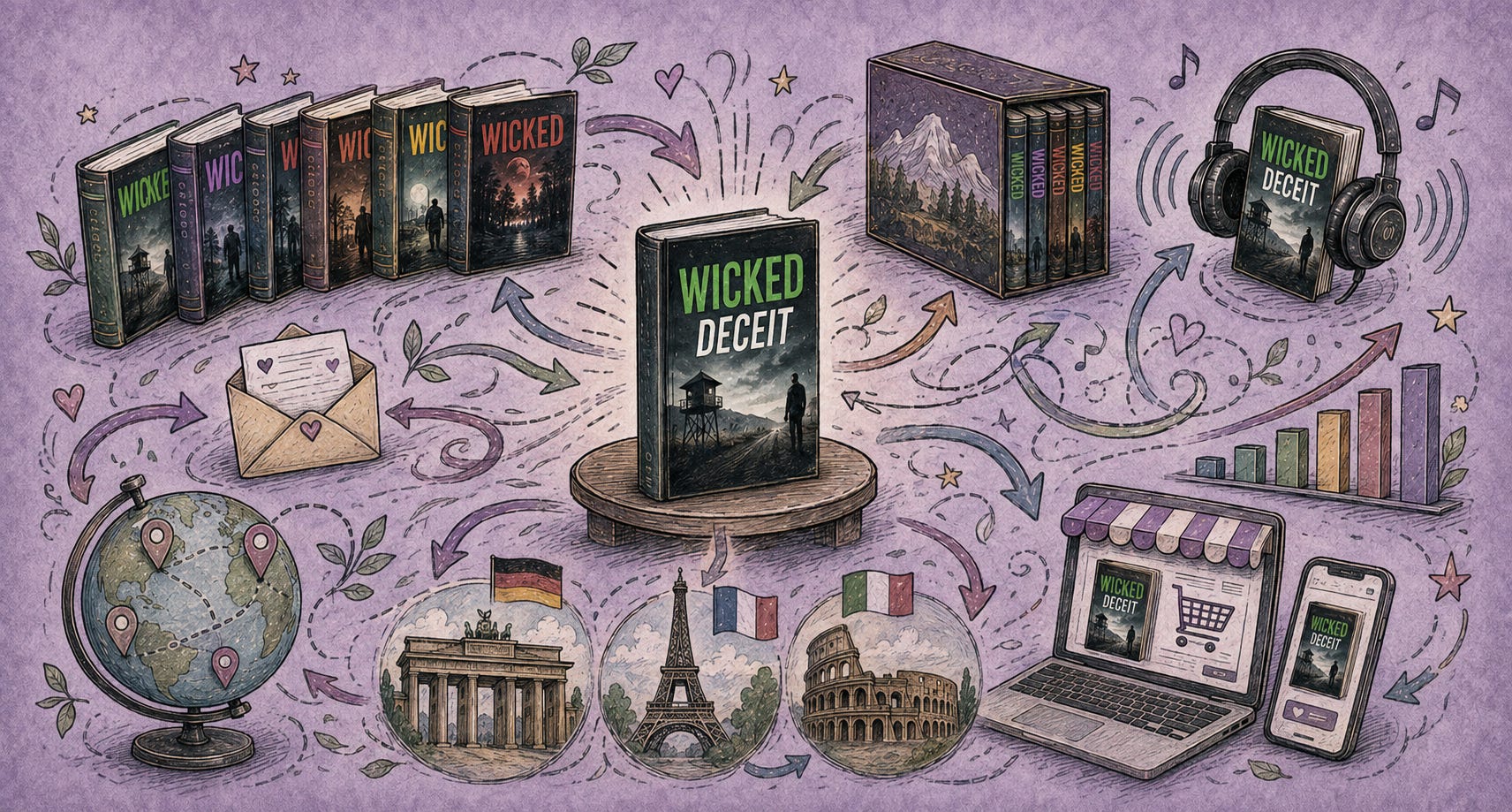
The machine I built, and what I’d do again
I didn’t publish my first book with a plan to sell 135,000+ copies across 13 countries.
I started with one book. One series. One market.
The countries come later in this article because they came later in the business too.
Before I had anything worth taking international, I had to build a catalog readers actually wanted to keep reading.
Start Small
At the beginning, I wasn’t thinking about markets or formats or translation. I was thinking about one thing: can I get the right reader to buy this book and finish it.
That meant narrowing everything down. One genre. One clear reader. One series. One primary market. I wasn’t worrying about Germany or audio or ten advertising platforms, because none of that matters if the first question isn’t answered yet.
For me, that meant Sam Wick and action thrillers first, nothing else. Once that had traction, I expanded into crime fiction with Aria Hunt, then supernatural thriller with Creed-Hart. Legal thriller, with Cal Justice, is the newest expansion. Each one only came after the series before it was already working, not alongside it.
Before you build anything bigger, you need a small machine that works. One book that reaches the right reader and gives them a reason to want the next one.
Write in Series, Not Isolated Books
135,000+ sales sounds like 135,000+ separate purchasing decisions. It isn’t.
A lot of those sales came from the same pattern repeating itself. A reader discovers Book 1, buys Book 2, buys Book 3, keeps going. One reader acquired once can turn into several book sales, Kindle Unlimited reads across multiple titles, future launch sales, and a newsletter subscriber who shows up again for the next series.
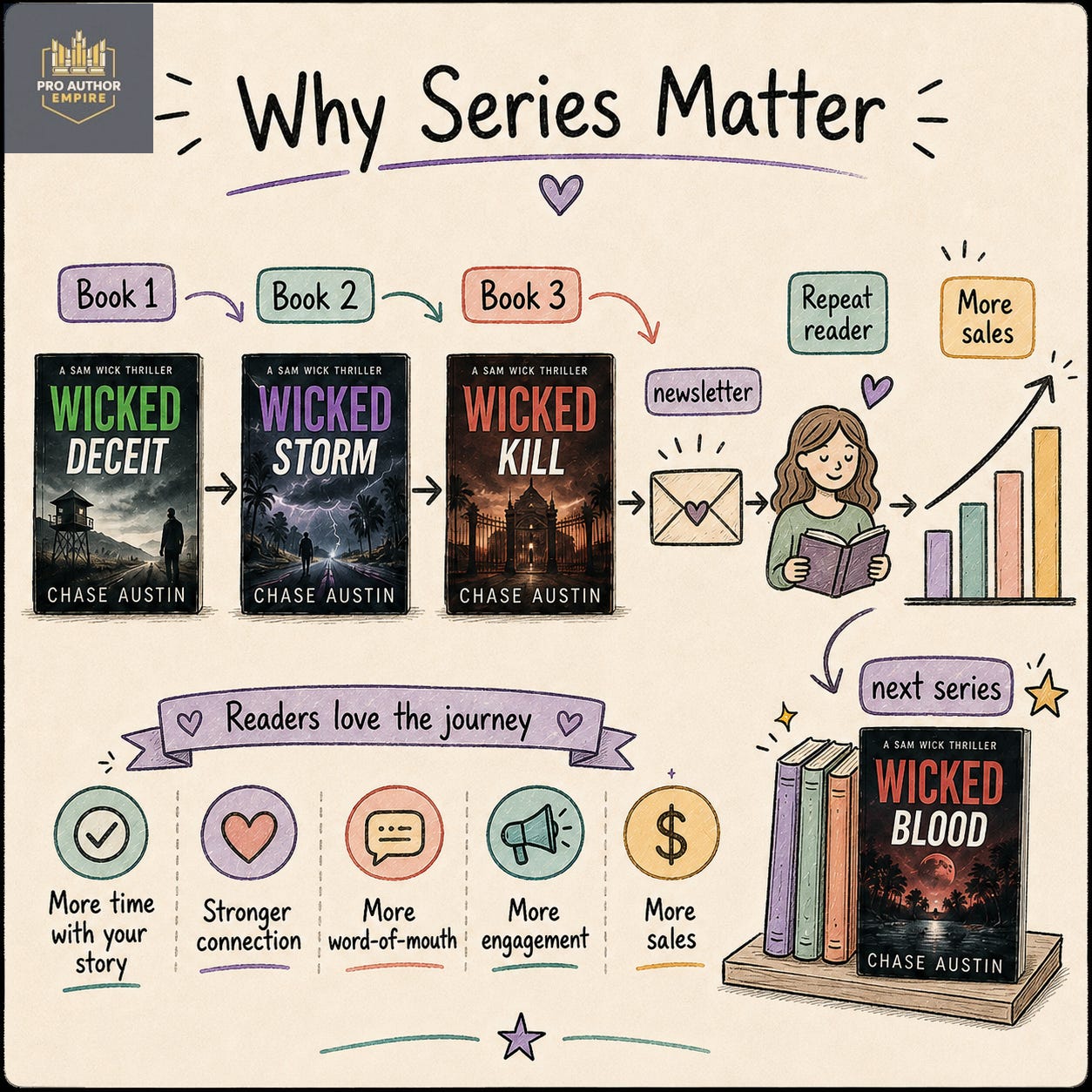
That changes the question you should be asking. Don’t just ask how many people bought Book 1. Ask how many of those Book 1 readers became Book 2 readers. That number, read-through, is where an author business actually starts. A book that sells well but doesn’t pull readers into Book 2 is a much weaker asset than a book that sells modestly but sends a strong percentage of readers into Book 2.
Give Every Series a Branding Readers Can Remember
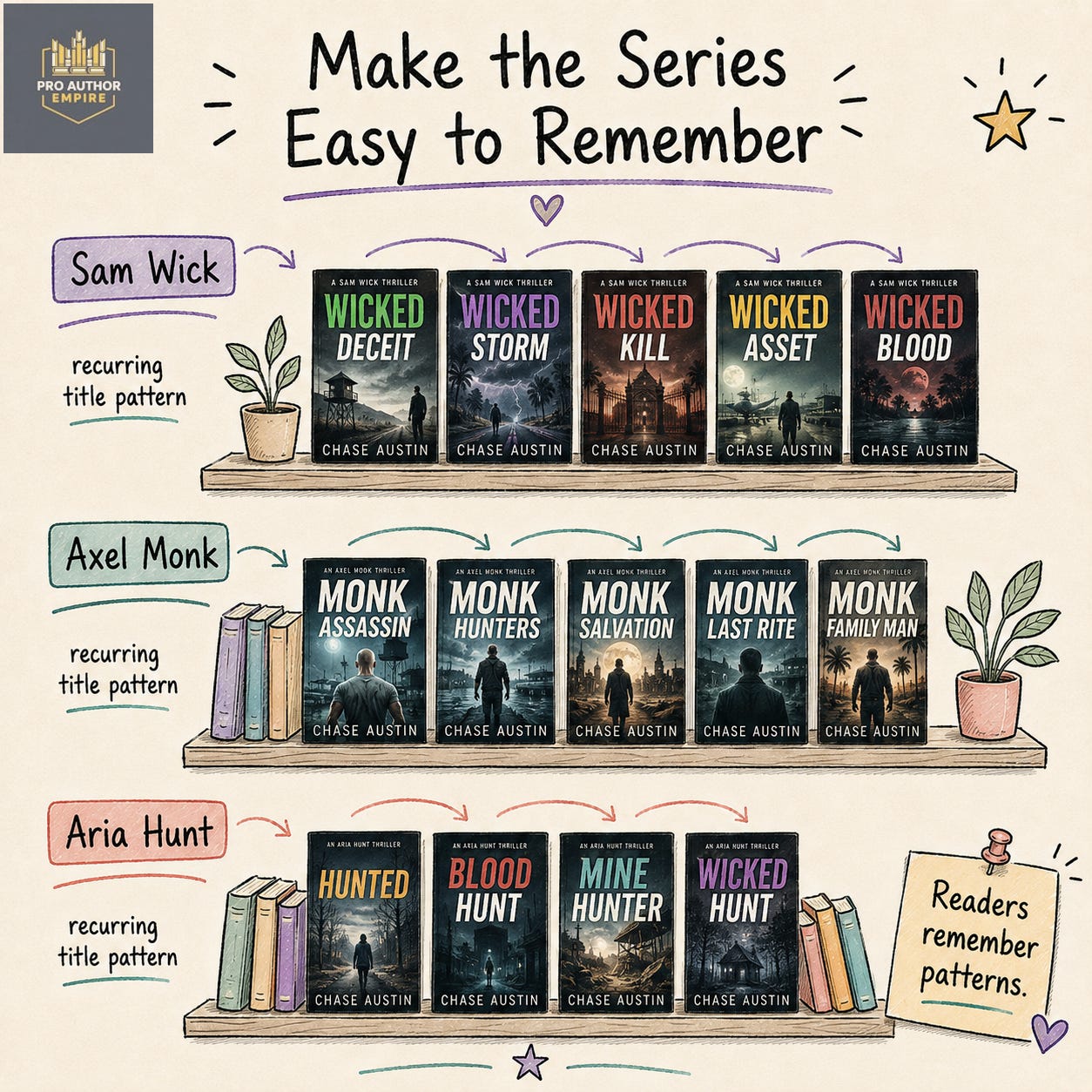
One of the simplest branding decisions I made was to give each series a consistent naming pattern.
For Sam Wick, that word is Wicked.
For Axel Monk, it’s Monk.
For Aria Hunt, it’s Hunt.
For Cal Justice, it’s Justice.
That recurring word becomes part of the series identity. A reader doesn’t have to remember every title perfectly, they just have to recognize the pattern. Readers may forget the exact title, but they remember the recurring word. If they’ve already read one Sam Wick book and they see another title using Wicked, the connection is immediate. Same with Monk. Same with Hunt. Same with Justice.
That consistency carries into the covers too. Similar typography, layout, color language, and genre signal make the books feel like part of the same family. But the naming does more work than the visuals alone, because it survives even when a reader only half-remembers the cover. A reader should be able to recognize the next book before they even read the full title.
It’s worth pairing this with something more operational: making the next book easy to actually find. A numbered series, clean back matter, a direct link to Book 2 at the end of Book 1. A reader finishing your book at one in the morning shouldn’t have to search for what comes next. That gap, between finishing a book and finding the next one, is where a lot of potential read-through quietly dies.
Build Your Email List Before You Need It
My newsletter mattered because it gave me a way to turn one-time discovery into repeat discovery. A reader who found me through Amazon once didn’t have to wait for Amazon to surface me again. I could tell them directly when the next book, series, or translation was ready.
Between launches, I send behind-the-scenes notes, cover reveals, excerpts, and the occasional offer, not just launch announcements. The list matters because without it, the reader relationship largely lives inside Amazon’s ecosystem, and you’re depending on their algorithm to reconnect you with someone who already liked your work.
Use Ads to Find New Readers
Ads work very differently depending on what’s behind them.
If an ad is pushing one standalone ebook with nothing behind it, the economics are weak. You spend to acquire a reader, and the relationship ends at that one transaction.
If an ad is pushing Book 1 of a series that reliably pulls readers into Book 2, Book 3, and a newsletter, the economics change completely. You’re not paying for one sale, you’re paying for entry into a catalog, which lets you spend more to acquire that reader because their value isn’t capped at the first purchase.
Ads didn’t build this business. They accelerated a catalog that was already designed to keep readers once it had them.
The Real Engine Is Repeat Readers
New authors tend to think about growth as a single number: how many new readers can I find. That’s acquisition, and it matters, but it’s only half the engine.
The other half is retention, getting readers you already have to buy another book. As the catalog grew, retention became increasingly valuable, because each returning reader had more books available to buy than they did the year before.
A meaningful share of the 135,000 isn’t 135,000 people making one decision each. It’s a smaller group of people making the same decision, to read another Chase Austin book, over and over.
Connect Your Series Into One Reader Ecosystem
Most advice stops at “write a series.” The next level is building series that feed readers into each other.
There are two kinds of read-through worth distinguishing.
Horizontal read-through is Book 1 to Book 2 to Book 3 within one series.
Cross-series read-through is Series A leading into Series B leading into Series C, a different mechanism and far less commonly talked about.
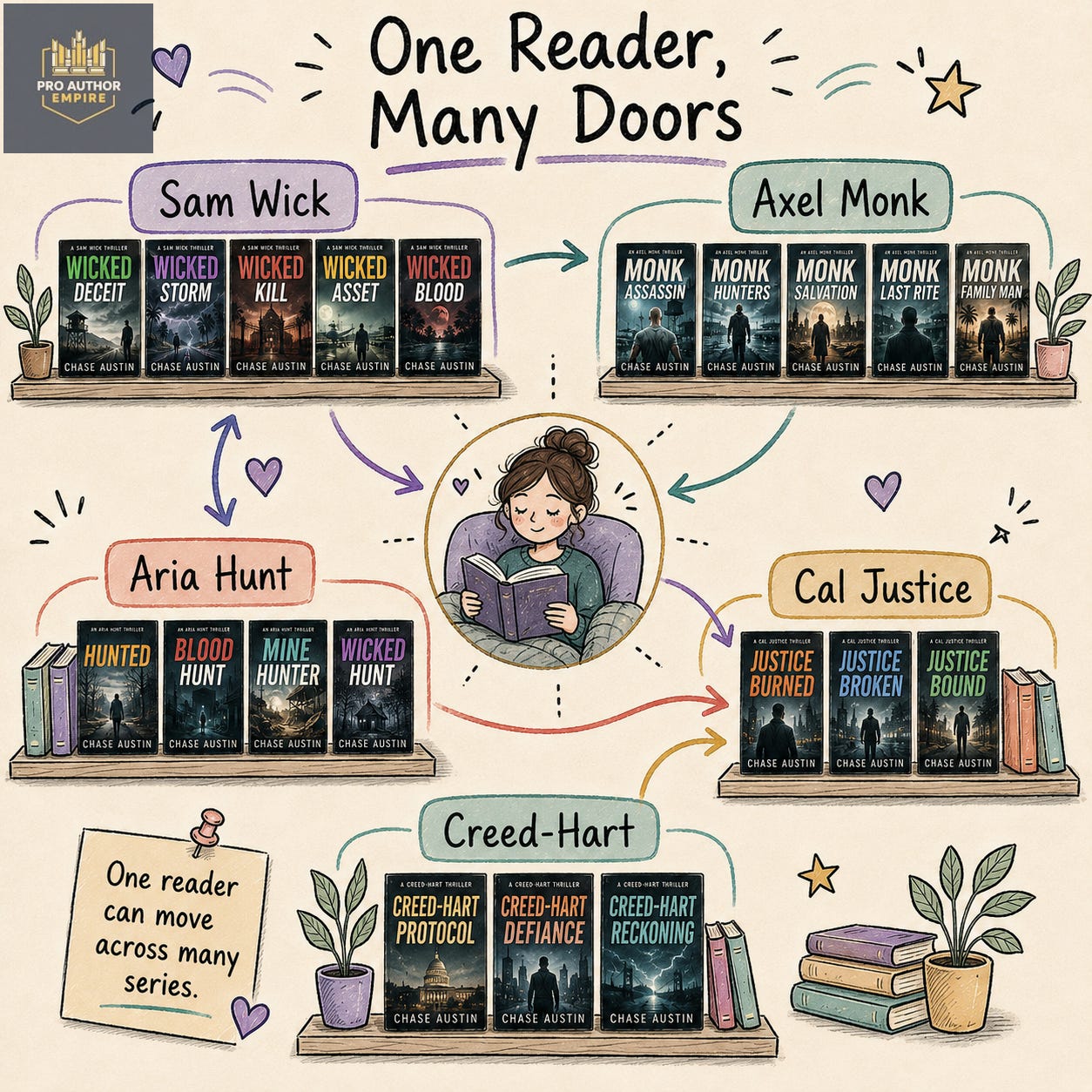
Right now, Axel Monk and Aria Hunt both appear in Sam Wick books, and Sam Wick appears in Aria Hunt books.
That’s not a coincidence or a one-off cameo, it’s a deliberate two-way bridge between series.
A reader who follows one of those threads has a natural, in-story reason to pick up the other.
I’m building this further.
Sam Wick is set to appear in Axel Monk books next. Further out, the plan is for Sam Wick and Aria Hunt to both appear in Cal Justice, along with another of my characters, Talon Creed. Each addition widens the web a little more, so a reader who starts anywhere in the catalog eventually has a path into everywhere else in it. Every crossover gives an existing reader a reason to sample a series they might otherwise never have tried, and it does that without costing me a dollar in ad spend, since it’s the story itself doing the discovery work rather than an ad pushing a stranger toward a new series.
The effect is that a reader’s lifetime value stops being capped at one series. I wasn’t just trying to build individual series that worked on their own. I wanted each one to function as another doorway into the rest of the catalog.
Here’s what that actually looks like for one reader moving through the system. Someone finds Sam Wick through Book 1, likes it, and reads through several more Wick books in a row.
Somewhere in that run, Aria Hunt shows up as a character.
That reader, already invested in the world, follows the thread and picks up Aria Hunt’s own series.
Later, Sam Wick appears back inside an Aria Hunt book, closing the loop between the two. From there, the next crossover I’m building, into Axel Monk or Cal Justice, gives that same reader another door to walk through.
That one reader can account for a dozen or more book sales without ever being counted as a dozen separate acquisitions. This is a large part of how 135,000 sales come from a much smaller number of actual people, and why my acquisition costs have stayed lower than they’d otherwise need to be. The catalog isn’t just a list of series sitting next to each other, it’s a system that keeps handing the same reader a reason to stay, and that system runs almost entirely on organic discovery instead of paid reach.
Core English Markets First
The United States has been my biggest market from the start.
The US is first, by a clear margin. UK is second. Then Australia, then Canada. Germany rounds out my top five, a spot it only claimed in the back half of 2025. It’s not ahead of Canada or Australia yet, but I think its ceiling is significantly higher once more of the catalog is translated and supported with ads. That’ll likely take a couple more years and some real spend behind it, not just organic translation reach. It’s the first sign of a story I’ll come back to.
I didn’t have to rebuild the book for each of these markets. Same manuscript, same series, largely the same cover. One English-language book had the potential to earn across four countries with almost no additional production work. That’s closer to distribution than localization, the story doesn’t change, the audience just gets bigger.
That has a ceiling, though. English-language reach only takes you so far. To go further, the books themselves had to change languages. That’s where the most interesting part of this story actually starts.
I also have paid sales in India, the Netherlands, Brazil, Mexico, and Japan, but these are smaller markets today, and I don’t pretend all 13 countries contribute equally.
Germany: Proof the Machine Works in Another Language
Germany is the freshest part of this story, and it’s the one I’d tell you to pay the most attention to.
The easy version of this lesson is “translation works.” That’s not really it. The real lesson is that translation economics change dramatically once you translate enough of a series to preserve read-through, the exact same mechanism that made the English catalog work in the first place.
For a long time, “international” for me just meant selling English editions outside the US. I’d had books available in German for a while before that, one or two titles here and there, without much happening. The real shift came this year, once more of the catalog became available in translation at the same time.
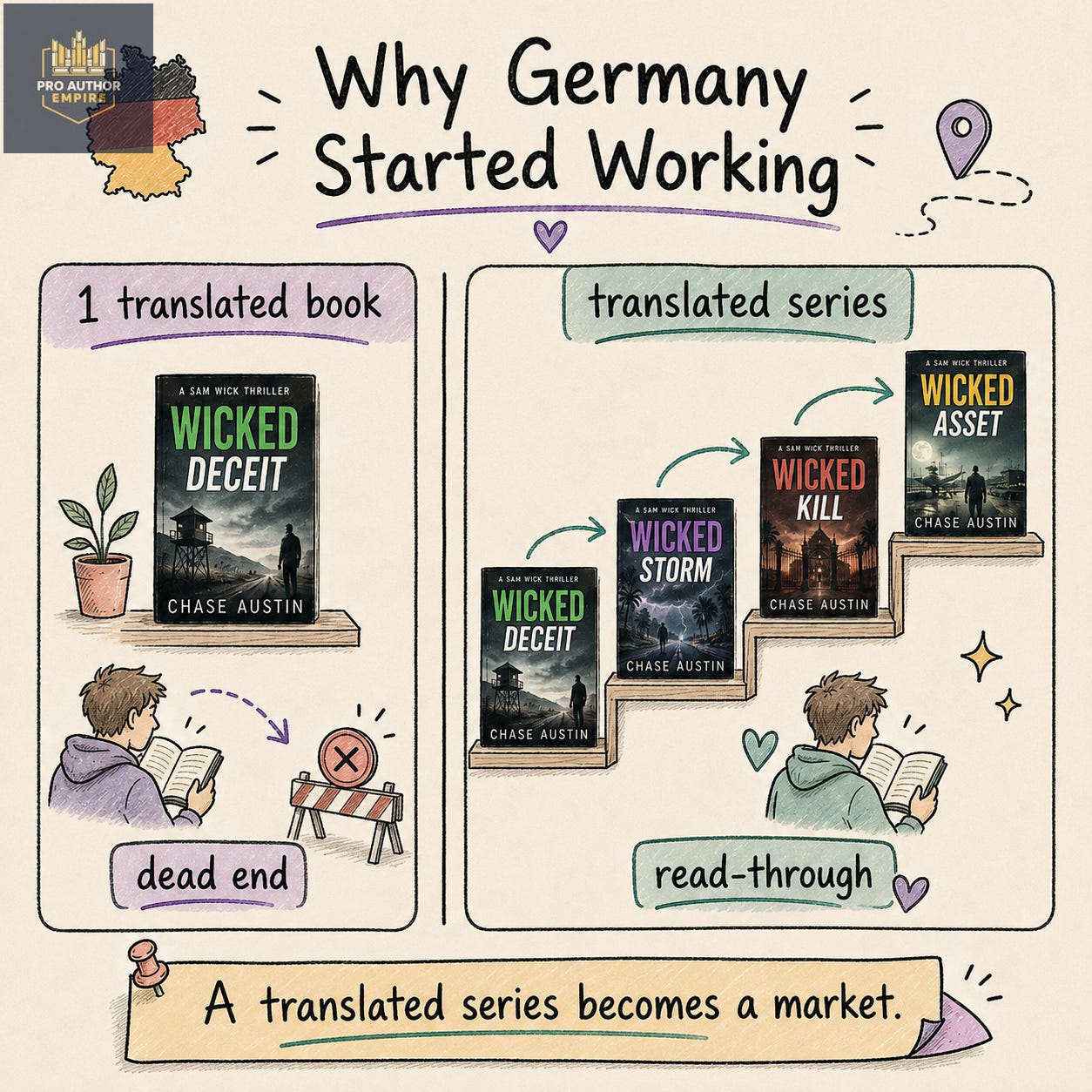
That’s the part worth sitting with. The English catalog worked because a reader who finished Book 1 always had Book 2 waiting. For years, the German catalog didn’t offer that. A German reader could find one translated Sam Wick book and then hit a wall, nothing else in their language to move to next. Once enough of the series existed in German at once, that wall came down, and the same read-through engine that built the English side of the business started reproducing itself in German.
The signal was hard to miss. I saw a sudden jump in German revenue with almost no ad spend behind it, just the translated backlist itself doing the work. That’s a different pattern than a title needing to be pushed. It’s a market responding to something simply becoming available to it, the same way US readers respond when a series they already love gets a new book.
I’m not running ads in Germany yet. The plan is to start once at least eight books in the Sam Wick series are translated, not before. That’s deliberate. I don’t want to pay to acquire a German reader who runs out of translated books to read after two or three, the exact mistake that would have wasted ad spend on a market that wasn’t ready for it yet.
One translated title gives the reader nowhere to continue. A translated series starts to become a market. Germany is the first place I’ve watched that transition happen in real time, and it’s the clearest evidence I have that this business isn’t just an English-language phenomenon. It’s a machine, and the machine appears to work in more than one language.
France, Italy, and Spain: Applying What Germany Proved
Germany is the proof. France, Italy, and Spain are where I’m testing whether it repeats.
I’m no longer thinking about translation title by title. I’m thinking in terms of translated series depth, because that’s the variable that actually moved the needle in Germany.
I don’t yet have enough data to claim these markets will follow Germany’s path. That’s the bet I’m making now, as more of the catalog becomes available in those languages.
One Story, Many Formats and Markets
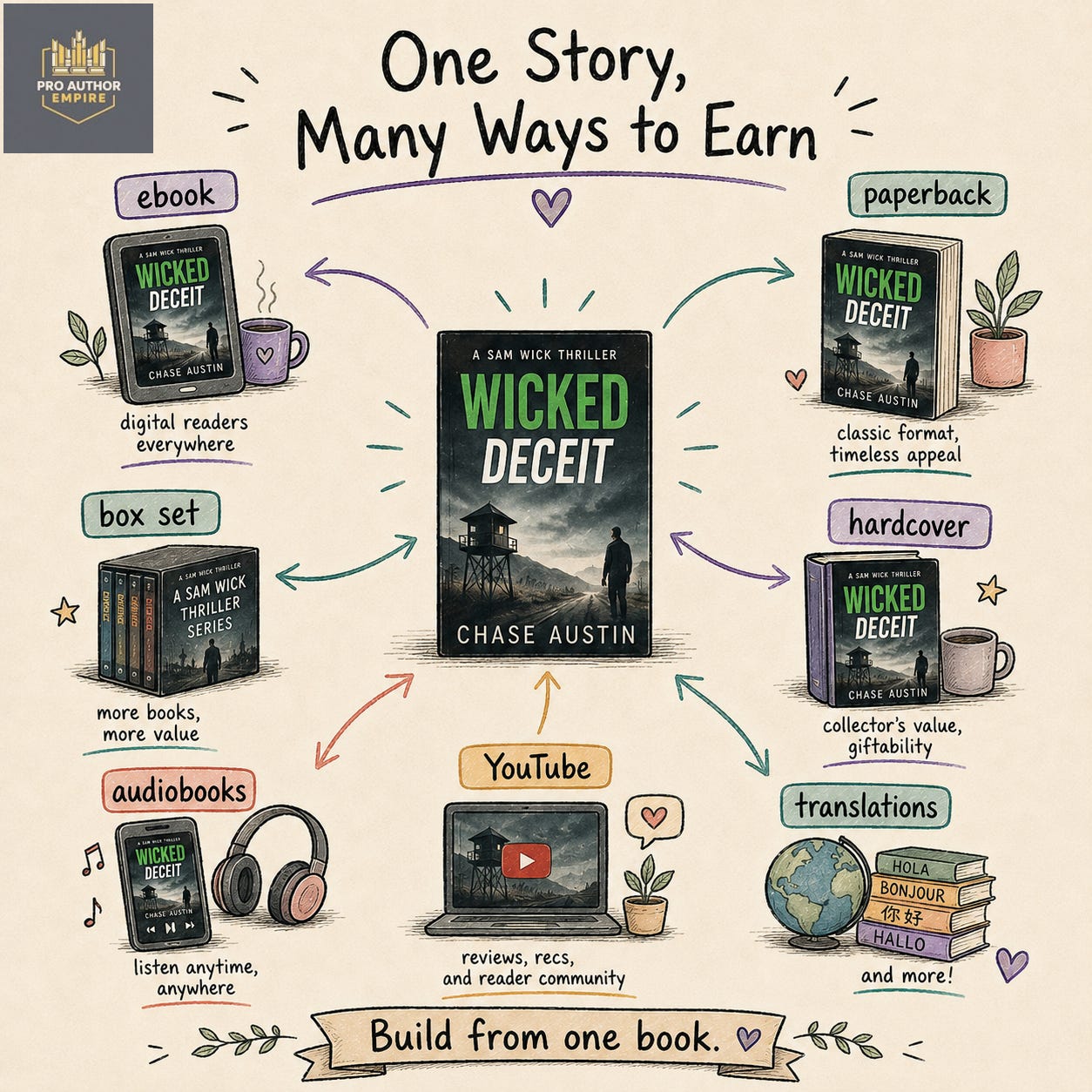
I wrote each story once. But a story can keep earning as an ebook, a paperback, a hardcover, a box-set component, or a translated edition in another market.
Audio is the next format I’m exploring because the stories already exist, although the economics still have to make sense title by title.
The point isn’t to maximize the number of products you can count. A German ebook and a German paperback aren’t valuable just because they’re two SKUs instead of one. The point is that a single creative asset can earn repeatedly across multiple consumption formats and multiple markets without requiring a new story every time. Sometimes the story already exists, and the opportunity is simply giving it a new format, a new language, or a new market it hasn’t reached yet.
What I’d Do Differently Starting Today
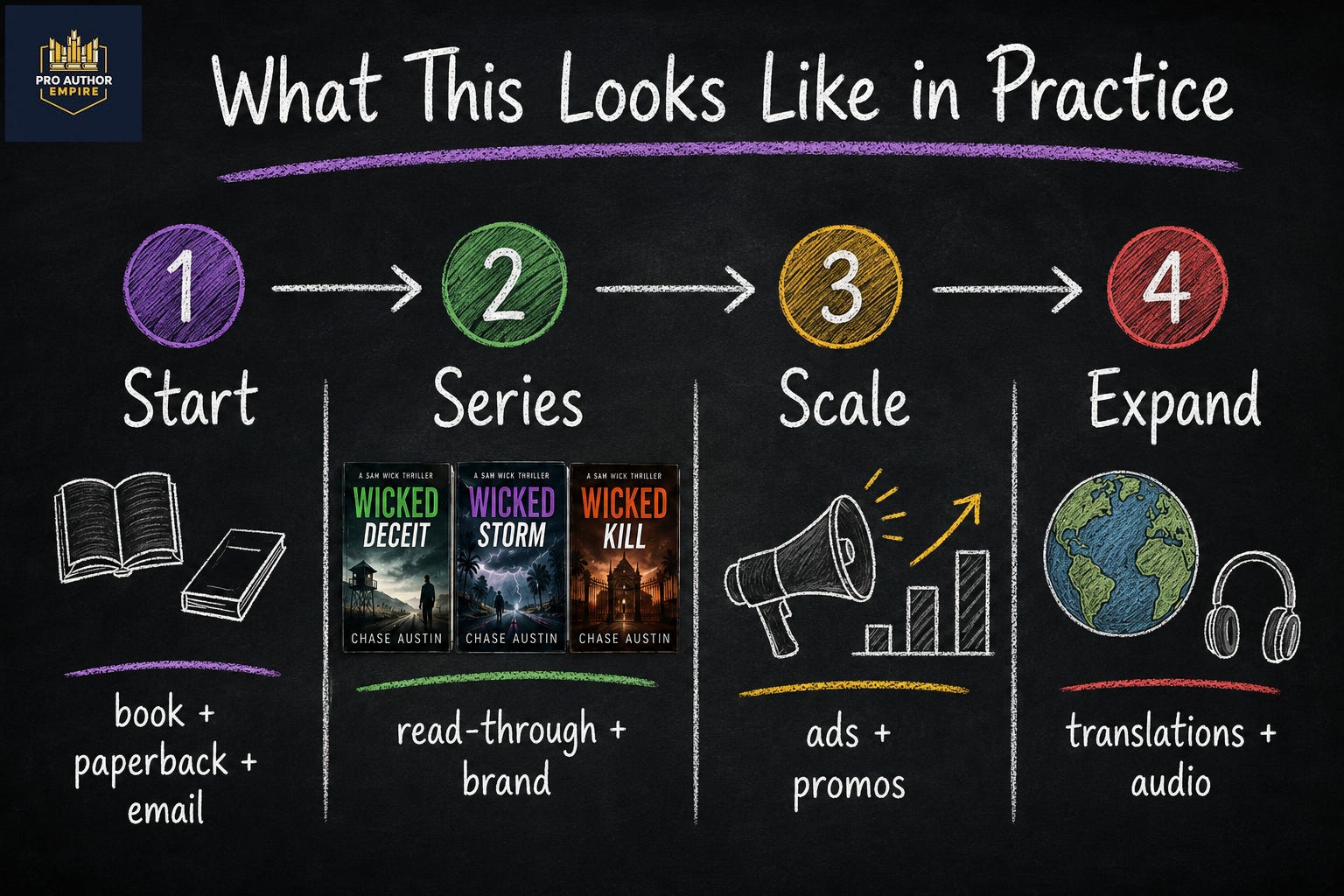
If I were starting from zero readers again, here’s roughly how I’d sequence it.
From the beginning: Write the series, establish the brand, put out ebook and paperback since readers expect both, and start collecting emails even if almost nobody is subscribing yet. Don’t let anything more expensive than that distract you from proving the core series works.
Once you have read-through data: Nurture the list in earnest and learn one acquisition channel properly instead of spreading across several. Once you can see how many Book 1 readers become Book 2 and Book 3 readers, you can start to estimate what a new reader is actually worth.
Once acquisition economics work: That’s the point where spending more to acquire a first-time reader starts to make sense, and where scaling ads or promos actually pays off.
Once the series is proven: Add the more expensive layers, audio, box sets, the next English-language market. Low complexity for the English markets, same books, more work for audio.
Once multiple series exist: Start building the connections between them.
If I were starting again, I’d wait to invest seriously in translation until I had enough of a proven series to translate several books together, rather than one title at a time.
I got some of this order wrong the first time.
Three, specifically.
I slowed down when I shouldn’t have. Early on I was publishing three to four books a year. Then from 2021 through 2023, that dropped to about one a year. That wasn’t just fewer releases. It meant fewer reasons for existing readers to return, slower backlist growth, and weaker economics behind every new reader I acquired. I’ve been picking the pace back up since late 2024, and the difference shows.
I also wrote too short for too long. My earliest Sam Wick books were considerably shorter than what I write now. Looking back, I think that cost some read-through, less time in the world meant fewer readers converting into repeat buyers. My average book length today is around 70,000 words, and that fits the experience I’m trying to deliver much better.
And I didn’t run enough promos. They’re one of the more reliable ways to boost earnings across a catalog like mine, and under-investing in them for years cost more than short-term sales. It meant fewer new readers feeding the email list, the ads, and the crossovers downstream. That’s something I’m actively fixing this year.
135,000 Was the Result, Not the Strategy
I never sat down with a strategy called “sell 135,000 books in 13 countries.”
I wrote the next book. Then I made it easier for readers to find the one after that. I built series, nurtured repeat readers, learned to acquire new ones, and connected those readers across my catalog. Eventually the same stories picked up more formats, languages, and markets.
None of those decisions looked like 135,000 sales when I made them.
Together, they became 135,000 sales across 13 countries.
The lesson isn’t to go global. It’s to build something worth taking global.